Improving Subscription Commerce Through Customer Journey Design

created for

Disney’s digital storefront suffered from customer confusion across browsing, checkout, and membership enrollment experiences. Analytics and customer feedback revealed this contributed to high drop-off during critical conversion moments. The challenge was to simplify the experience while clarifying the program's value proposition.

My Role: Senior UX Designer (CX Strategy, Interaction Design)
Timeframe: ~1–2 months
E-COMMERCE
CX STRATEGY
CONVERSION OPTIMIZATION
UX RESEARCH
Cropped image of left half of a laptop screen, showing a SaaS dashboard of assets under review for approval, with columns for status and activity.
THE CHALLENGE
Reduce severe cart abandonment and improve conversion through a clearer commerce experience.
Analytics revealed unusually high cart abandonment and widespread customer confusion throughout the Disney Movie Club shopping experience. Customers struggled to understand the relationship between membership enrollment, bundled offers, product formats, and the purchasing process itself. A solution needed to be delivered on an aggressive timeline of a little more than one month.
UNDERSTANDING THE EXPERIENCE
A UX audit uncovered the patterns behind customer abandonment.
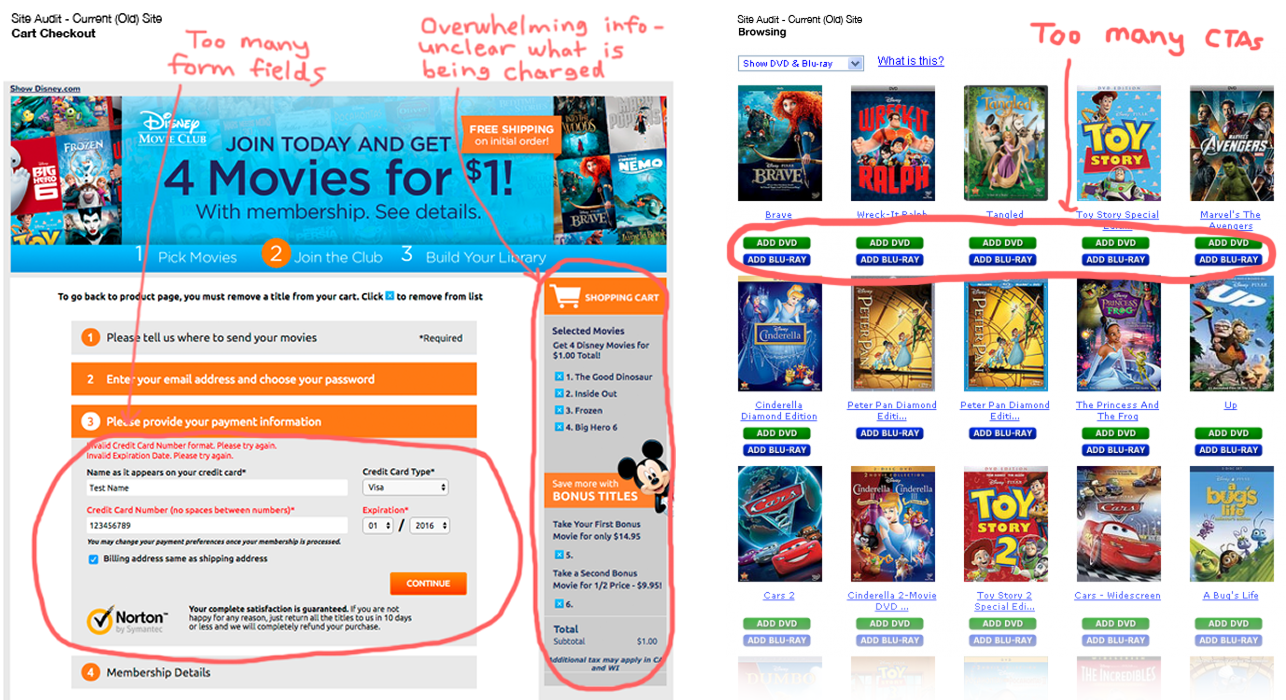
Working from existing analytics, customer feedback, and support data, I conducted a rapid UX audit of the existing experience to understand why customers abandoned the purchasing process. Rather than treating individual pages as isolated problems, I evaluated the end-to-end customer journey, identifying recurring issues around value proposition clarity, product discovery, checkout complexity, and competing decision points that prevented customers from completing their purchase.
Image: A collage of screenshots from a presentation showing a site audit with markups for issues and a list of issues found.
DEFINING THE CUSTOMER JOURNEY
A customer journey framework transformed fragmentd signals into a strategic blueprint for redesign.
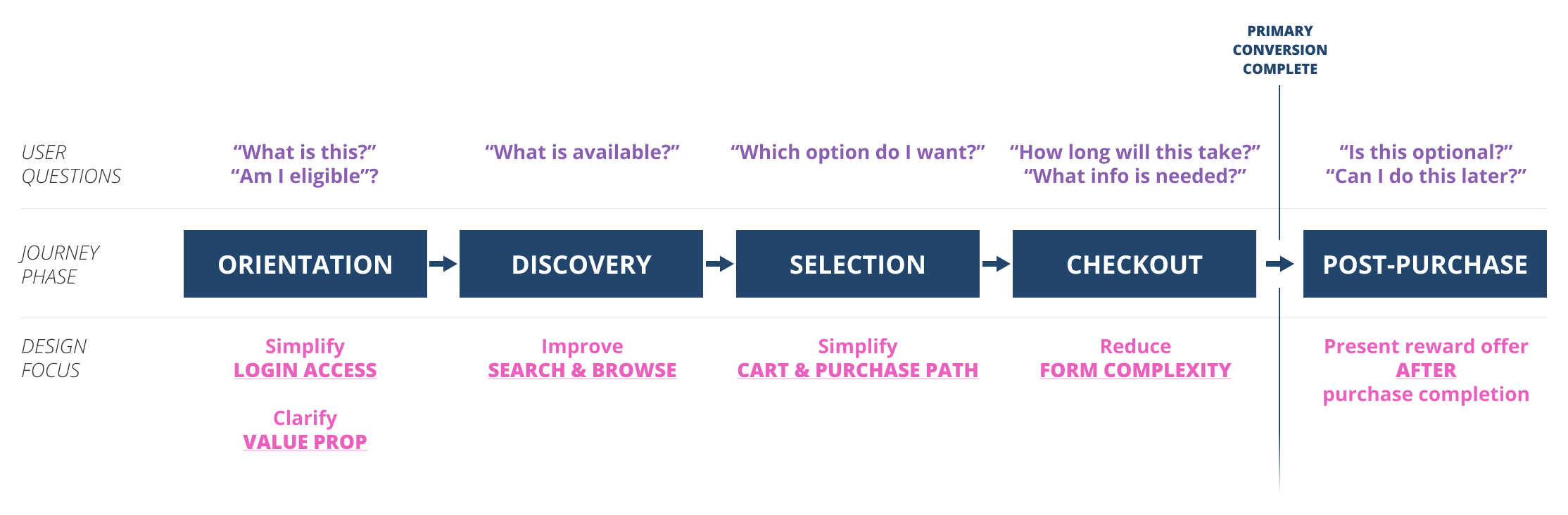
To quickly organize those findings, I created a lightweight customer journey and task analysis that mapped the end-to-end experience around customer intent rather than individual pages. The framework clarified where customers became confused, why they abandoned purchases, and established the structure for redesigning the experience from discovery through post-purchase rewards while focusing design effort where it would have the greatest impact.
Image: A condensed customer journey diagram shows distinctive Journey Phases labeled Orientation, Discovery, Selection, Checkout, Post-Purchase, with corresponding User Questions and Design Focus goals to resolve those questions.
EXPERIENCE ARCHITECTURE
Restructuring the purchasing experience around customer intent.
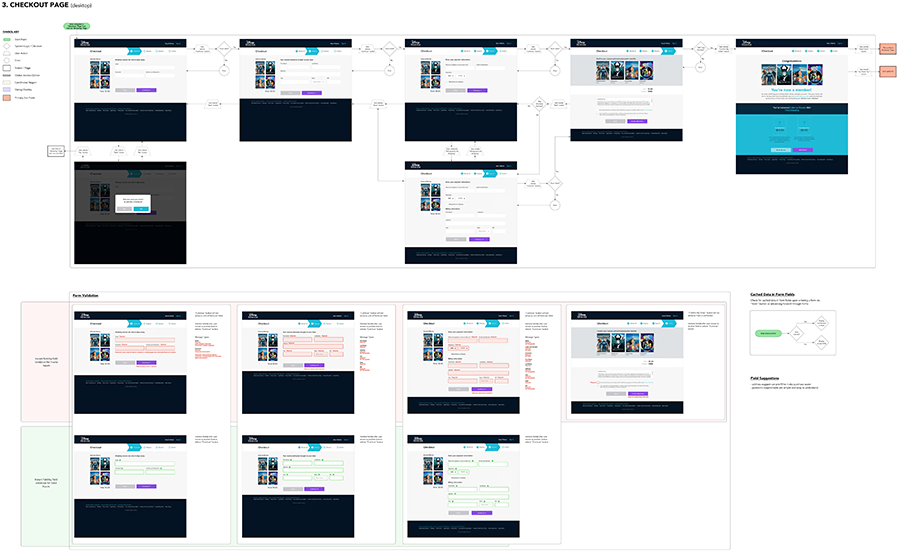
I reorganized the purchasing flow around the customer's natural decision-making process, separating primary purchase decisions from optional membership rewards. The redesigned customer journey became the blueprint for information architecture, interaction flow, and implementation. Working within a compressed timeline, I partnered closely with developers to define user stories, write specifications, refine interaction details, and validate implementation throughout development.
Image: A screenshot shows complex flow diagrams mixed in design comps.
VALUE PROPOSITION CLARITY
Clarifying the subscription model before customers made purchase decisions.
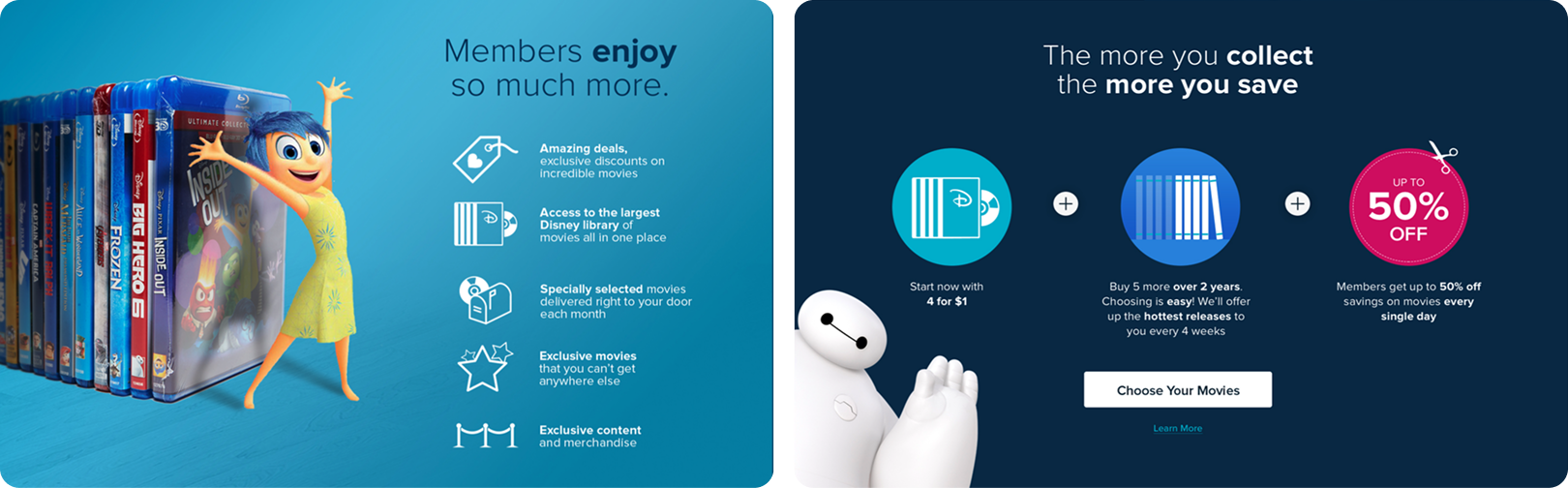
Promotional messaging was reorganized to clearly separate core purchasing decisions from optional membership rewards. By moving optional rewards communication after the primary purchase decision, the experience reduced confusion while preserving the visibility of Disney Movie Club's unique value proposition.
Image: Two screenshots side-by-side of new designs that communicate the value proposition.
PRODUCT DISCOVERY
Simplifying browsing and selection through clearer e-commerce flows.
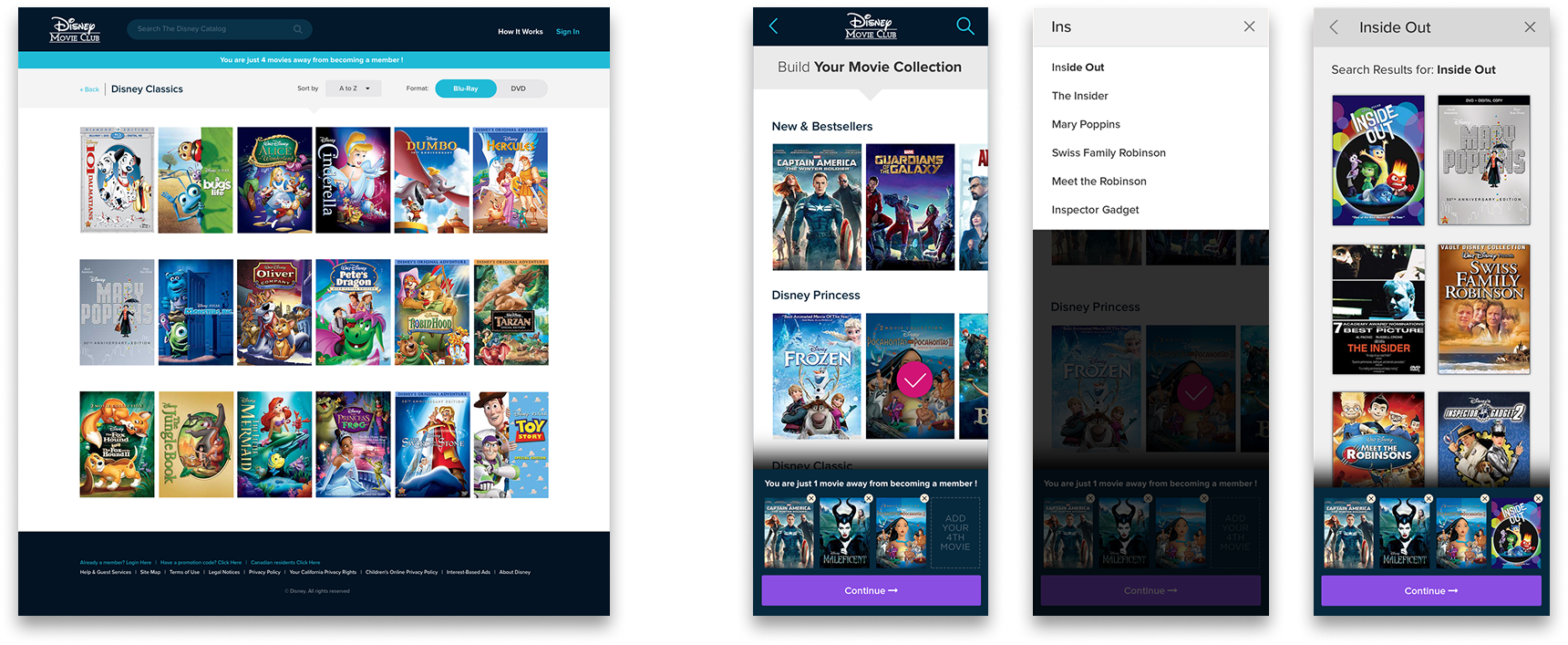
Browsing experiences were simplified through improved product organization, persistent shopping cart visibility, live search, and clearer messaging that reduced cognitive load while helping customers understand available products and offers.
Image: A series of screenshots show the user interface for browsing, searching and selecting movies to add to your cart.
CHECKOUT EXPERIENCE
Reducing friction during the highest-impact conversion moment.
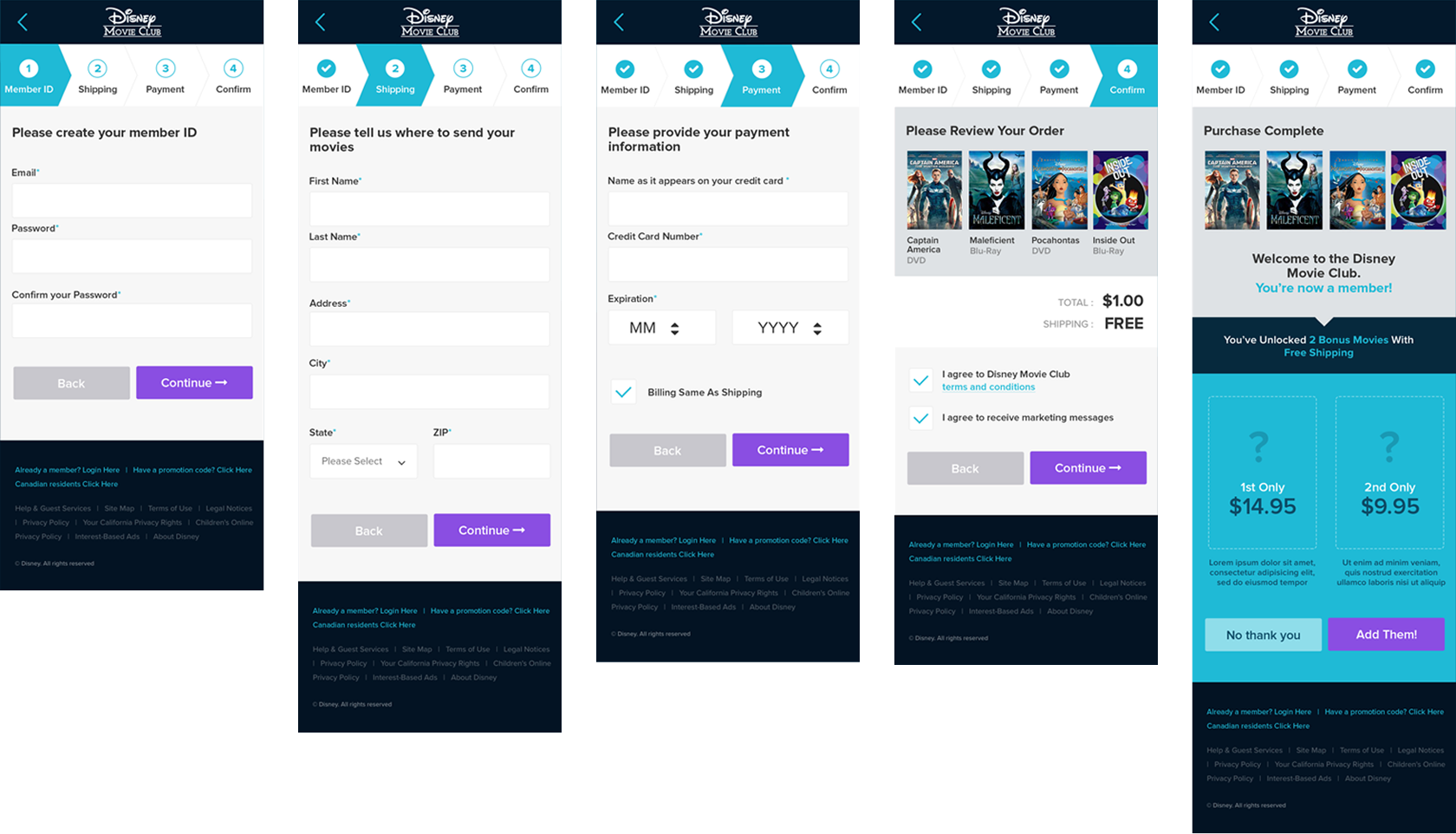
Checkout introduced progressive disclosure, simplified forms, clearer hierarchy, and a streamlined purchasing sequence that reduced cognitive load during the highest-friction stage of the customer journey.
Image: Screenshots of multi-step UI for Checkout.
OUTCOME
A simpler purchasing experience with measurable business impact.
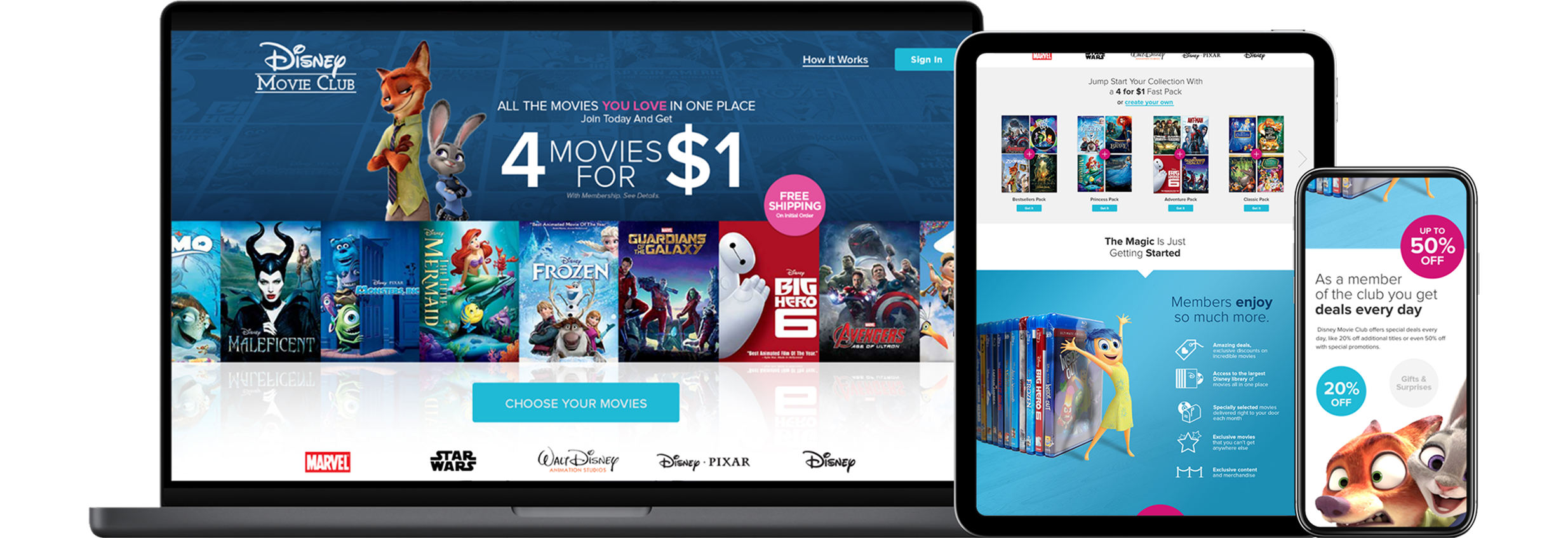
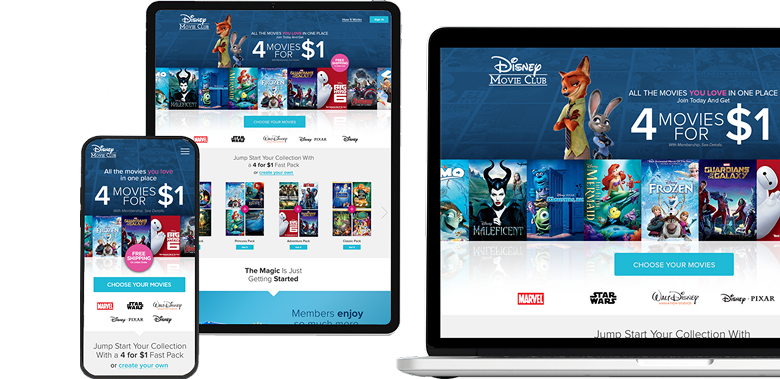
The redesigned experience reduced cart abandonment by approximately 88% while increasing overall site engagement by more than 20%. By clarifying the value proposition, restructuring the purchasing journey, and simplifying checkout, the redesigned experience remained the foundation of Disney Movie Club's commerce experience for years after launch.
Image: A collage of devices, including desktop, tablet, and mobile is shown with the UI in them.
END OF CASE STUDY SUMMARY
Full case study available with additional research and design documentation.